Protect customer uptime
Use developing changes as evidence for earlier investigation and better-informed service decisions.

DCC INTELLIGENCE CAPABILITY
DCC supplies governed real-time and historical machine data, then connects returned model output to the relevant asset, time window and operating context. Service teams review the result and decide what action to take. The value is not the score itself; it is the informed service decision that follows.
Learn what predictive maintenance in manufacturing means, how it differs from preventive maintenance and where it can create operational and commercial value.
Why it matters
Connected machines generate more than operational data. Their behavior can help an equipment manufacturer identify where service attention is needed, support customers earlier and turn specialist knowledge into a repeatable capability across the installed fleet.
Use developing changes as evidence for earlier investigation and better-informed service decisions.
Direct specialists towards the machines and time periods that deserve review.
Build differentiated service agreements and digital services around equipment already in operation.
Combine machine knowledge, historical behavior and confirmed service outcomes so the use case becomes more useful over time.
The starting point is not a large AI programme. It is one valuable maintenance question with measurable operational and commercial outcomes.
Artificial intelligence
The broad field
Machine learning
Learns patterns from numerical machine and time-series data to detect, predict or classify.
Deep learning
Multi-layer models, including the model family behind LLMs.
What kind of AI is this?
Numerical industrial data is a natural fit for focused machine-learning models. A bounded use case is faster to test, easier to maintain and easier for service teams to review than a broad AI programme.
LLM interface: possible future scope
A language assistant could later help explain results or prepare reports. It is not part of the current capability described here.
Fleet overview
Across a fleet, these results help teams narrow thousands of signals and operating periods to the machines that deserve attention.
Fleet overview
Production assets
Selected asset
Line A · Pump 04
Illustrative concept
Highlight unusual behavior for human review.
Estimate when a defined condition may occur.
Rank likely issue types and support the response.
Predictive maintenance combines these model jobs: detect behavior that has changed, predict when a defined condition may occur and classify the likely issue so the service team can respond.
Delivery choice
These are parallel delivery options, not maturity steps. The right choice depends on the customer's capabilities, the use case and agreed responsibility boundaries.
The model runs in the customer's environment. DCC provides governed access to relevant real-time and historical data, plus an API path for returning model output.
The customer uses a standardized DCC model designed for a defined use case, without needing to operate its own ML capability.
Inuatek develops a customer-specific managed model when a standardized model does not provide sufficient accuracy or functionality for the specialized need.
A future AI copilot could add a language interface for explanation, reporting and troubleshooting; it is not currently part of these options.
Bring your own model
For the customer-owned option, the model stays in the customer's environment. DCC provides authorized data access and receives model output through an API for review in machine context.
Inuatek monitors data delivery
The customer's ML model evaluates authorized data in the customer's own environment.
Customer monitors its own model
DCC connects the returned result to the relevant asset, time window and operating context so a service team can review and act.
Predictive maintenance example
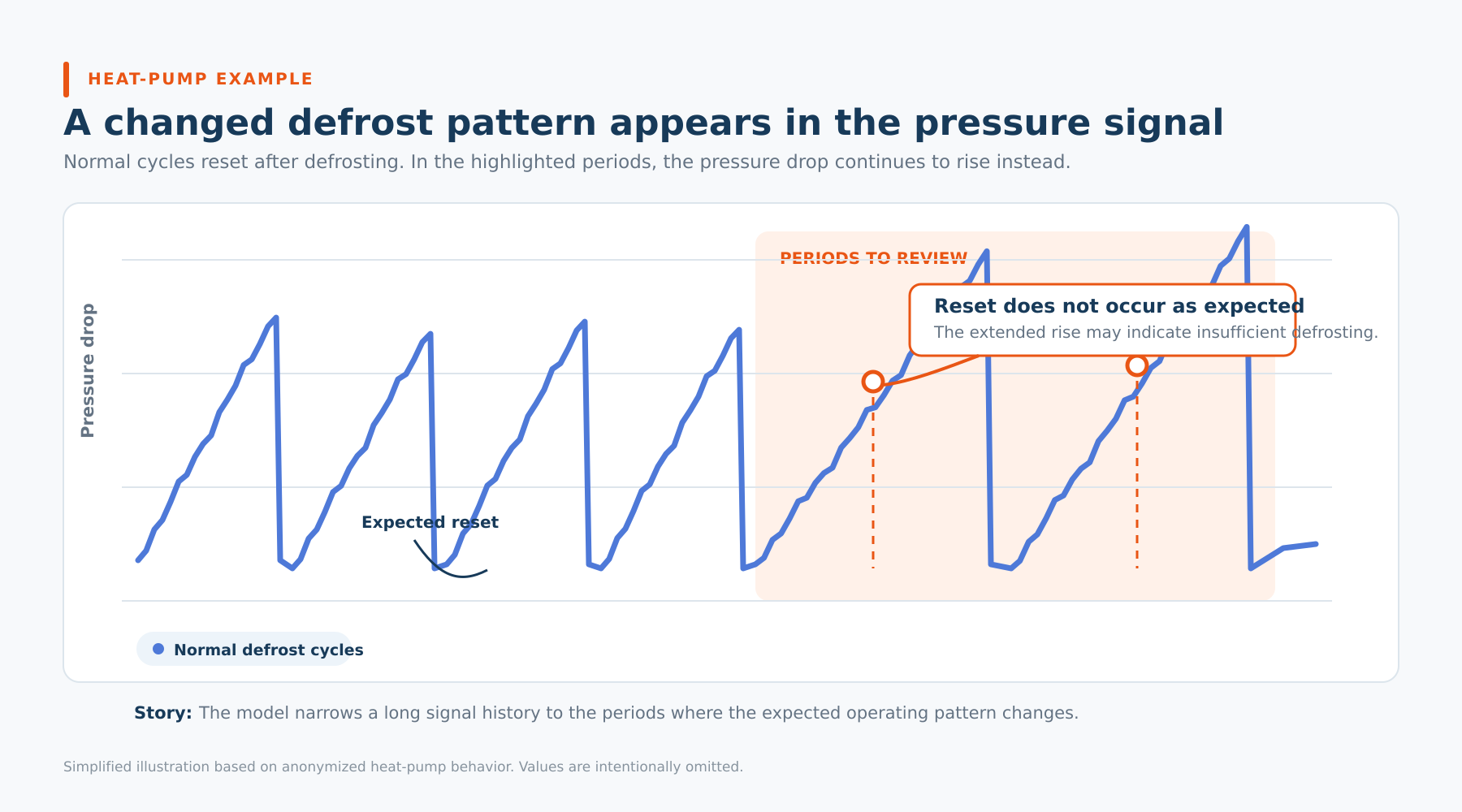
A heat pump can show repeating pressure-drop cycles during normal operation. After defrosting, the signal should return to its expected pattern. In this example, that behavior changes and creates a period worth reviewing for possible insufficient defrosting.
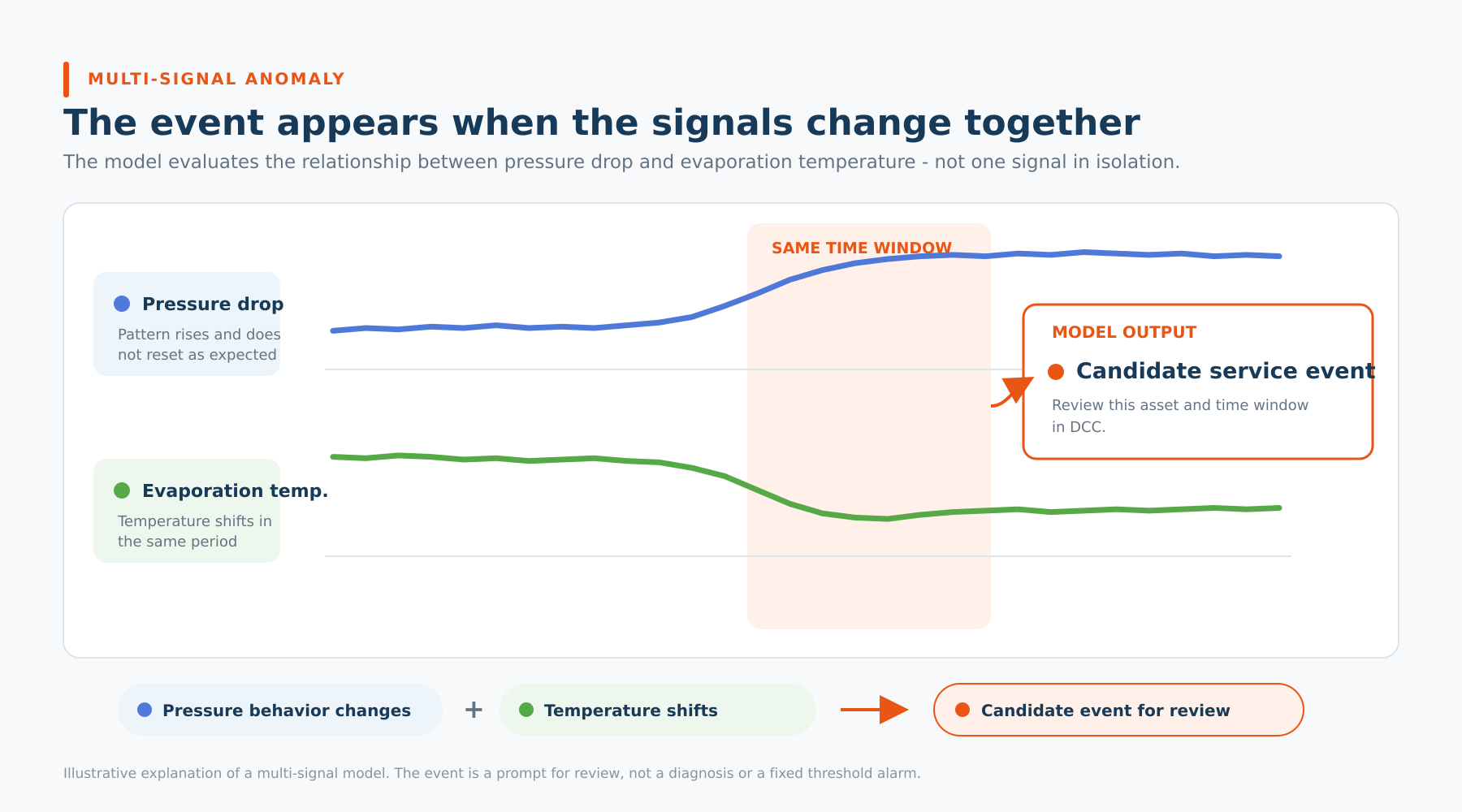
Instead of asking a technician to scan every historical trend, anomaly-detection models evaluate the new period against earlier operation. The illustrations separate the explanation into two parts. First, the pressure-drop pattern stops resetting as expected. Second, the pressure behavior and evaporation temperature change in the same time window, and the model raises a candidate event for review.
DCC connects the candidate period to the asset and operating context. The event is not a diagnosis and does not by itself predict compressor failure. A technician still decides whether it reflects a defrosting issue, another operating condition or sensor behavior.
Beyond fault detection
The example above uses machine signals (pressure and temperature behavior) to flag periods worth a technician's review. Measured performance is a different task: industrial process-heat reporting relies on separately metered heat flow and the outlet temperature, recorded simultaneously so delivered heat can be quantified over time.
Machine signals such as pressure, temperatures and operating states feed anomaly detection and fleet-wide service. They help service teams spot deviations and review candidate events across installations.
Calibrated heat-flow metering plus simultaneously monitored outlet temperature create a quantified heat-delivery basis, suitable for performance analysis and, where a project requires it, monitoring and reporting reviewed by an independent verifier.
When configured for a project, DCC can connect these data streams and organize the historical basis for analysis and reporting. Project measurement hardware, data mapping and verification remain project-specific responsibilities.
Explore heat-pump data & IF26 reportingDCC review concepts
The heat-pump example shows anomaly detection in practice. The following concepts show how the same DCC pattern supports human review, condition forecasting and likely-cause ranking across other machine types.
Anomaly review
Pump 04 · Line A
Window
14:20–14:38
Signal
Vibration
Asset state
Running
Review decision
Assign operational context
Illustrative concept
Forecast & classification
Defined operating condition
Condition estimate
18–24 h
Likely issue types
Illustrative concept
Illustrative notification
A notification can direct a person to the relevant machine, model output and supporting data. The recipient still reviews the context before deciding what to do.
These are candidate anomaly-detection methods, not proof of predictive accuracy. A use case may compare or combine suitable methods, then validate them against historical events and technician review.
MAD
Flags values that sit unusually far from the expected average.
IF
Flags unusual observations that can be separated from the rest in fewer steps.
LOF
Flags points that are sparse compared with their nearest operating neighbors.
PCA
Flags behavior that does not fit the main relationship between correlated signals.
Technical evidence
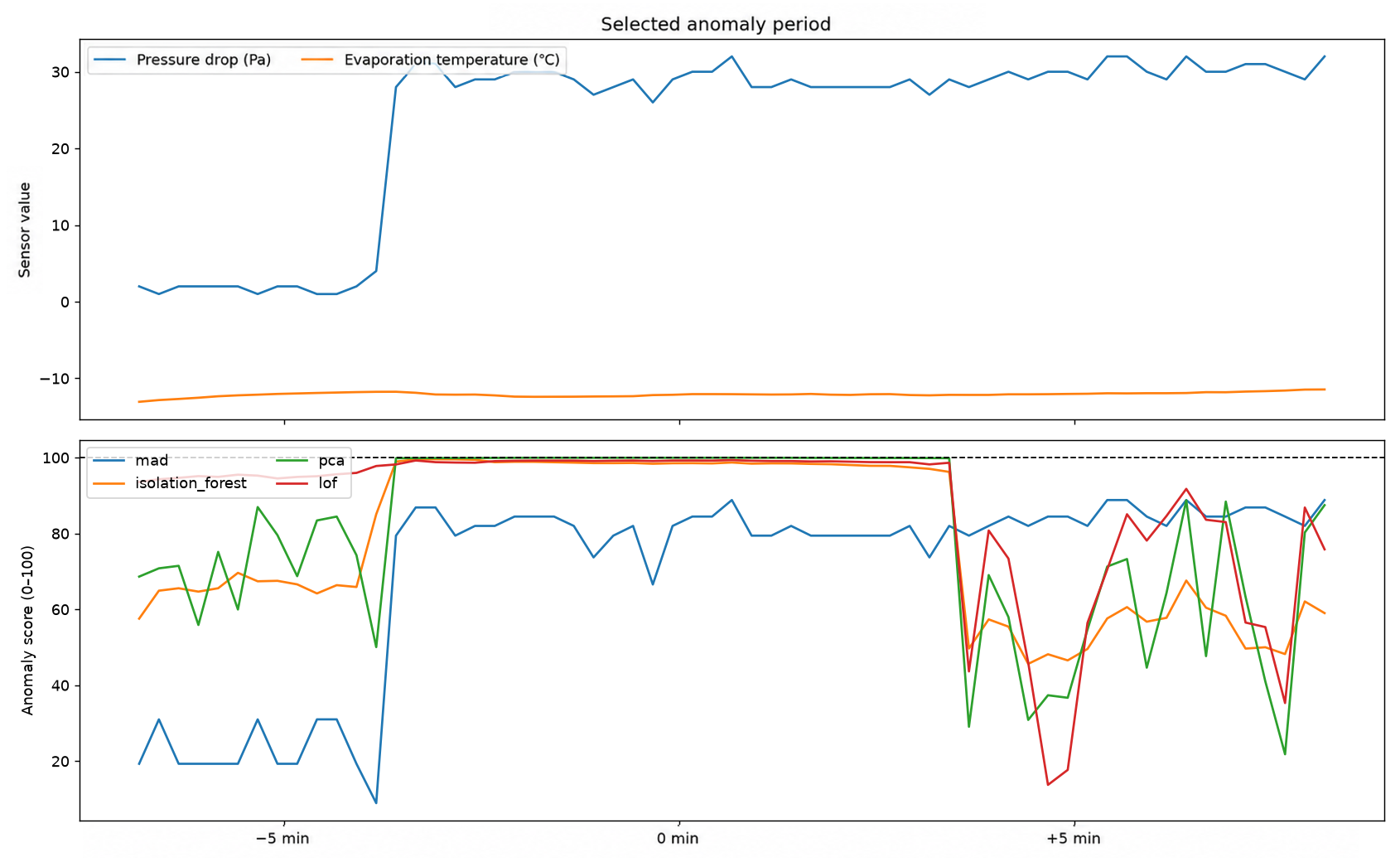
Every use case needs an operational owner, an acceptance criterion, data and model responsibility, a review workflow and ongoing monitoring. Run a bounded shadow pilot before operational rollout.
Pilot requirements
Related content
Bring a machine type, a set of operating signals and the service question you want to answer. We will help map the data, pilot scope and review workflow in DCC.
Discuss a predictive maintenance pilot