
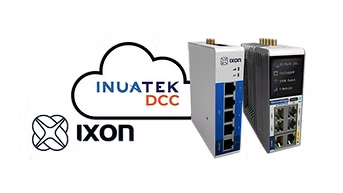
IXON Cloud and DCC: who does what
IXON Cloud is the remote access cloud and DCC is the data and dashboard platform. They solve different parts of the same job, so most machine builders use both.
- IXON Cloud (remote access cloud): secure VPN remote access, router management in Fleet Manager and configuration of the data logging service
- IXrouter3, SecureEdge or SecureEdge Pro: the edge gateway at the machine, reading PLC tags over protocols such as OPC UA, Modbus, Siemens S7 and EtherNet/IP and publishing them over MQTT
- Inuatek DCC: dashboards, alarms, reports, data history, customer access and fleet views across every connected machine, with IXON remote access built into the dashboards
IXON models and DCC support
DCC supports every gateway in IXON's edge range: IXrouter3, SecureEdge and SecureEdge Pro. Each one publishes its logged tags to DCC through the same custom MQTT broker in IXON Cloud, with a DCC client certificate of its own.
- IXrouter3: IXON's proven compact gateway for secure remote access and data logging, with firmware 3.24 or higher for MQTT logging
- SecureEdge: IXON's compact industrial edge gateway, IEC 62443-4-2 certified, for secure connectivity and machine data logging; IXON lists firmware 5.0 or higher for its logging features
- SecureEdge Pro: extra computing power, expandable storage and Docker support for edge applications, connected to DCC in the same way; IXON lists firmware 5.0 or higher for its logging features
The gateway you already have in the field stays. DCC reads the data it logs, so connecting does not require new hardware.
IXON remote access inside DCC dashboards
DCC includes an IXON remote access widget, so the alarm, its history and the machine's HMI sit on the same dashboard. Service engineers go from a warning to the machine without switching tools.
- Sign in with your IXON account, including two-factor authentication
- Link the widget to the gateway at the machine
- Open a VNC session to the machine's HMI directly inside the dashboard
Users sign in with their own IXON account, so the access rights you manage in IXON Remote Access Cloud still apply.
IXrouter3 highlights
- Built-in VPN and remote access to PLCs, HMIs and other control systems
- Local logging and buffering of machine data
- Ethernet, RS-232, RS-485 and USB connectivity
- Trigger-based data logging at the edge
How IXON MQTT to DCC works
The gateway publishes logged tags to a custom MQTT broker configured in IXON Cloud. For DCC, that broker is the Inuatek DCC MQTT broker. The IXrouter3, SecureEdge and SecureEdge Pro all do it the same way.
According to IXON, data logging to an MQTT broker is included with its edge gateways at no extra charge, and the gateway buffers data locally while the connection is down.
- MQTT data logging enabled on the gateway in IXON Cloud
- Gateway firmware that supports MQTT data logging: firmware 3.24 or higher on the IXrouter3, firmware 5.0 or higher on the SecureEdge and SecureEdge Pro, according to IXON's requirements
- Encrypted MQTT over TLS on port 8883
- Authentication with a device-specific client certificate and key generated by DCC
- JSON message format, selected in the IXON Cloud broker settings
One custom broker in IXON Cloud serves your whole fleet. Each gateway is added as its own client with its own DCC certificate.
Set up the IXON MQTT connection in five steps
- 1In DCC, create an IXON IXrouter3 device using the router's MAC address as Device Identifier, and download the certificate package
- 2In IXON Cloud, under Admin, Device settings, MQTT, add a custom broker with the DCC broker host, port 8883, the ca.crt file and JSON message format
- 3Add a client to the broker using the client.crt and client.key files from the certificate package
- 4In Fleet Manager, open the router's data logging service, enable Use custom broker, select the DCC broker and set the topic to the MAC address followed by a slash, e.g. C0:D3:91:33:42:43/
- 5Push the configuration to the gateway and confirm the incoming tags in the DCC Data viewer
The same steps apply to the IXrouter3, SecureEdge and SecureEdge Pro. The IXON setup guide under Technical resources walks through every screen, and the setup video shows it end to end in five minutes.
Frequently asked questions
Which IXON routers can send data to DCC?
All of them. DCC supports every gateway in IXON's edge range: the IXrouter3, the SecureEdge and the SecureEdge Pro. Each publishes to DCC with the same MQTT custom broker setup in IXON Cloud. MQTT data logging needs a gateway firmware that supports it: firmware 3.24 or higher on the IXrouter3 and firmware 5.0 or higher on the SecureEdge and SecureEdge Pro, according to IXON's requirements.
Does IXON MQTT cost extra?
Not on the IXON side. IXON includes data logging to an MQTT broker with its edge gateways, so you only pay for the gateway. DCC is licensed separately; see DCC pricing for the plans.
What happens to IXON data when the connection drops?
The IXON gateway buffers logged data locally and sends it to DCC once the connection is restored. DCC allows temporary headroom for these catch-up uploads after an outage.
Do I need a username and password for the IXON MQTT connection?
No. Each gateway authenticates to the DCC MQTT broker with its own client certificate and key, downloaded when you create the device in DCC. The username and password fields in IXON Cloud stay empty.
Do I need a separate MQTT broker in IXON Cloud for every router?
No. Create the DCC custom broker once in IXON Cloud and add each gateway to it as a client with that gateway's own certificate and key.
How do I choose where the IXON data appears in DCC?
The MQTT topic starts with the router's MAC address, matching the Device Identifier in DCC. To place the tags under a specific collector, append dcc/data/ and the collector name, e.g. C0:D3:91:33:42:43/dcc/data/PLC1.
Can I use IXON remote access from DCC?
Yes. Add the IXON remote access widget to a DCC dashboard, sign in with your IXON account and link it to the router. The VNC session to the machine's HMI then opens inside the dashboard.