
Start with the signals already in the field
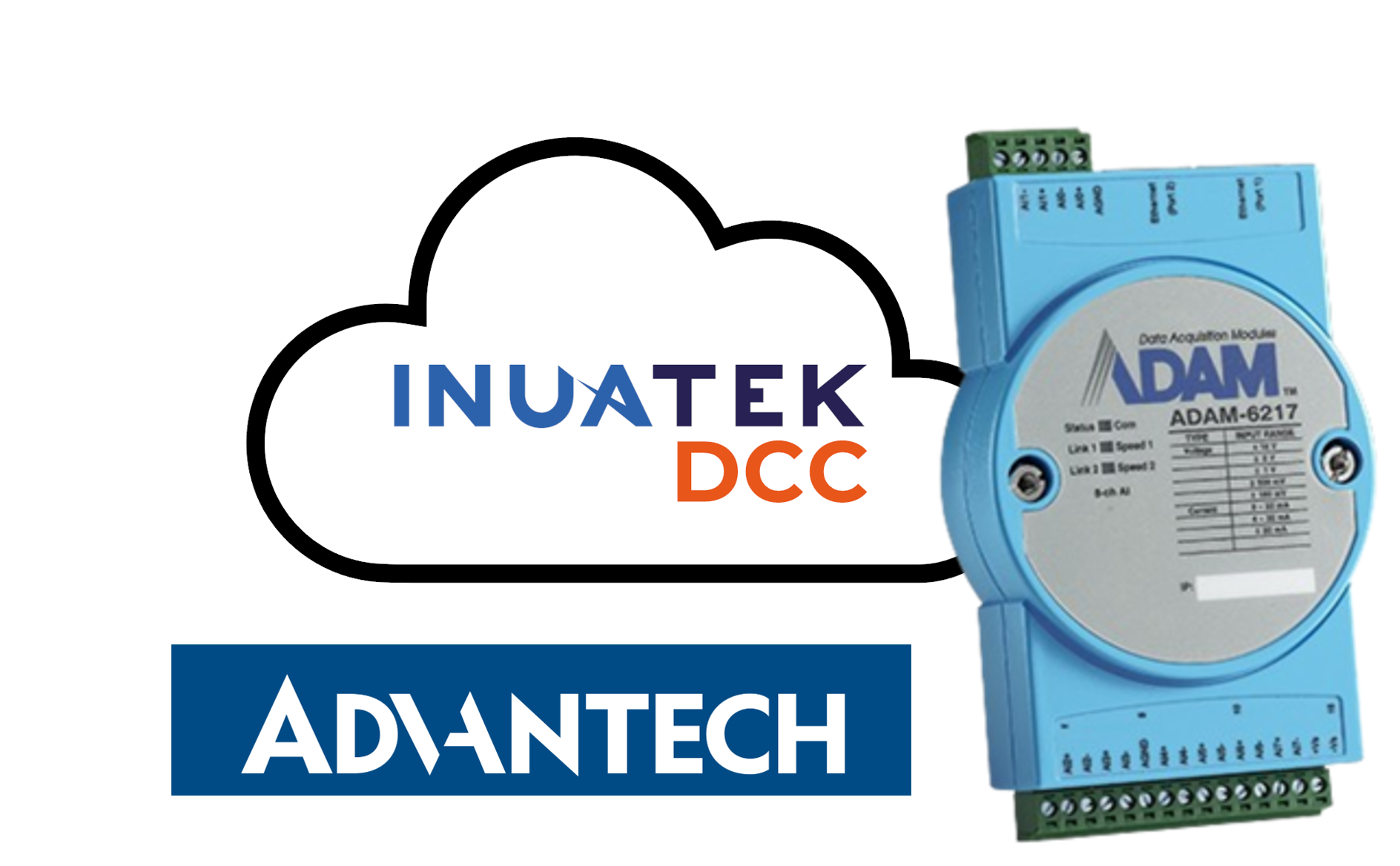
ADAM Ethernet remote I/O modules bring analog measurements, temperature inputs, digital states, counters and relay I/O onto Ethernet. Available signal types vary by model. The image on this page shows an ADAM-6217 analog input module with dual Ethernet ports and daisy-chain networking.
Examples include the ADAM-6017 for analog input, ADAM-6024 for mixed I/O, ADAM-6050 for digital I/O and ADAM-6217 for analog input. These products are Ethernet remote I/O modules, not cellular modems.
What ADAM brings
Capabilities available across selected ADAM-6000 and ADAM-6200 models include compact distributed data acquisition, local Graphic Condition Logic, configurable MQTT publishing with intervals and TLS, and daisy-chain networking on selected ADAM-6200 units.
Capabilities depend on the exact module and firmware. No single feature set should be assumed across the wider ADAM catalogue.
What DCC adds
The ADAM integration adds fleet and individual device dashboards, historical trends, configurable threshold alarms and notifications, reports, and role-based access across customers and sites.
The ADAM connection uses encrypted MQTT with username/password authentication.
ADAM support will be included in the DCC 7.4 production release. The scope does not include OTA updates, direct configuration management, remote access, or write and control through DCC for ADAM.
Model and firmware scope
Advantech's ADAM-6000/6200 MQTT manual explicitly covers ADAM-6017, ADAM-6018+, ADAM-6024, ADAM-6050, ADAM-6051, ADAM-6052, ADAM-6060 and ADAM-6066, plus ADAM-6217, ADAM-6224, ADAM-6250, ADAM-6251, ADAM-6256, ADAM-6260 and ADAM-6266. The overall ADAM-6000 catalogue is broader than this documented MQTT scope.
Model, firmware, I/O configuration and MQTT topic and payload details will be checked during onboarding. Configuration details and supported model and firmware requirements will be published with the DCC 7.4 release. ADAM-6015 and ADAM-6022 are not presented here as verified merely because they appear in the wider catalogue.
Plan an ADAM pilot
- 1Identify the ADAM model, firmware and required I/O signals
- 2Define the monitoring views and alarms the pilot should provide
- 3Review MQTT and security interoperability for the selected hardware
- 4Set up the pilot with ADAM support in DCC 7.4
- 5Plan how approved dashboards can be reused across sites
Contact Inuatek now to review the intended scope and prepare the pilot for the DCC 7.4 release.